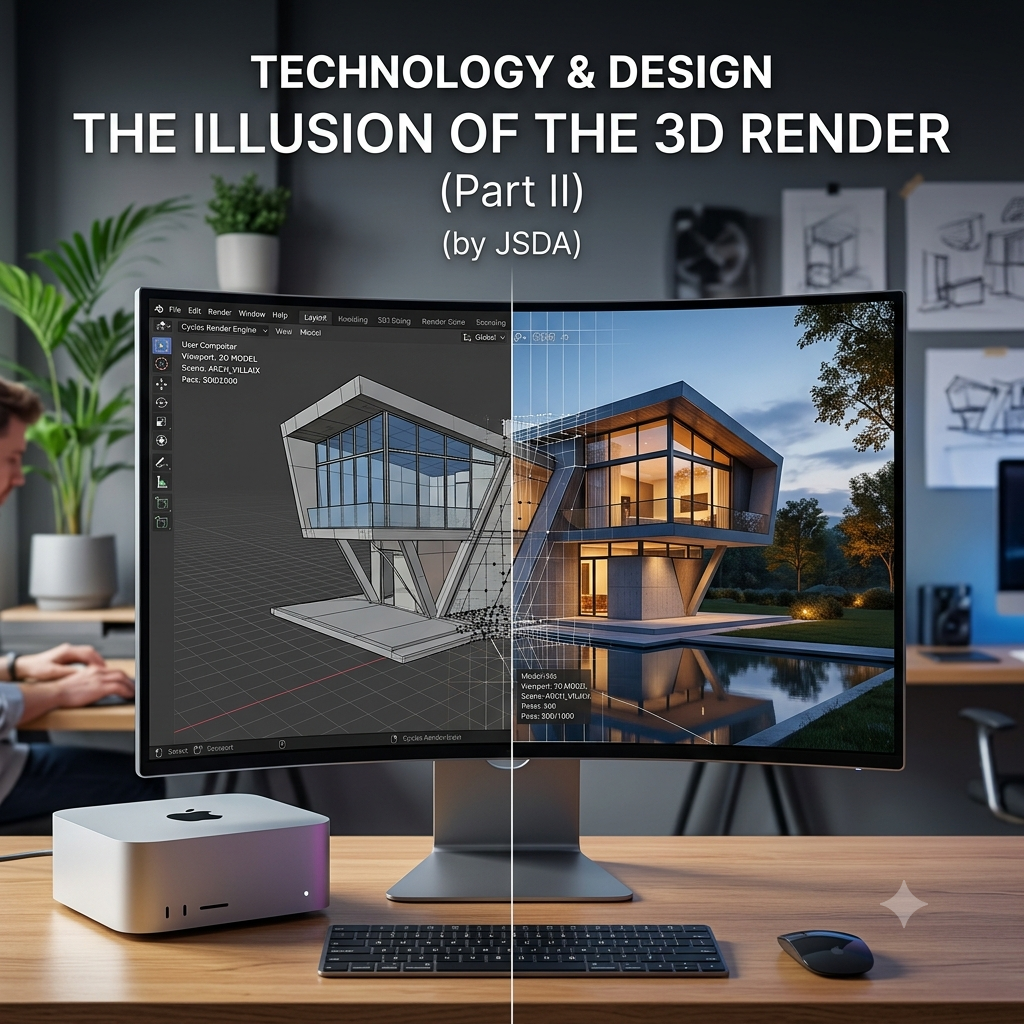
Have we become so good at visualizing design that we are slowly losing the ability to imagine it?
This is one of my growing concerns as a designer.
Technology has transformed the way we design and communicate. Today, a client can walk through a space on a screen long before a single wall is built. Materials can be changed in seconds. Lighting can be adjusted. Furniture can be moved. An entire environment can be created, edited and presented before anything exists in the physical world.
There is no question that this has made design more accessible and easier to communicate.
But perhaps we have also created a new problem.
We have started expecting design to prove itself before it exists.
Increasingly, I find that clients want to see everything before they are willing to believe in it.
Show me the material. Show me the lighting. Show me the final look. Show me the render.
And I understand why.
A render provides reassurance. It removes uncertainty. It gives us something tangible to react to.
But design has never been about certainty alone.
Design has always required imagination.
Before renders, architects and designers relied on drawings, models, material samples, sketches and, perhaps most importantly, their ability to communicate an idea that did not yet exist.
There was an element of trust involved.
You had to imagine the morning light entering through a window.
You had to imagine how a stone would feel when you touched it.
You had to imagine how the proportions of a room would affect you when you actually stood inside it.
You had to imagine how one space would lead into another.
And perhaps that uncertainty was not a weakness.
Perhaps it was part of the magic.
A render shows you an image. It does not necessarily show you an experience.
This distinction is becoming increasingly important to me.
A render can communicate proportion beautifully. It can help us understand scale, composition, colour and spatial relationships. It can allow a client and designer to arrive at a common visual language.
But there are things a render struggles to capture.
The softness of afternoon light.
The imperfection of a handmade surface.
The depth of a natural stone.
The way a material changes throughout the day.
The sound of a room.
The temperature of a space.
The way your body responds to scale.
Or that inexplicable feeling when everything comes together and a space simply feels right.
These are not necessarily things you can put into a render.
And then there is the other side of the problem.
A render can lie beautifully.
The right camera angle can make a room feel larger.
Perfect lighting can make an inexpensive material look luxurious.
Reflections can be manipulated.
Textures can be perfected.
Objects can be placed with impossible precision.
Everything can be made to look finished, polished and convincing. But a beautifully rendered space is not necessarily a beautifully designed space.
It is possible to create a spectacular image of an average design. And equally, it is possible for an exceptional design to look rather ordinary in a 3D view.
That is because a render is not reality.
It is an interpretation of reality.
And like any interpretation, it is selective.
This is where I believe designers need to be careful.
We should use technology to communicate our thinking—not to replace our thinking.
A 3D visualisation should help answer questions:
- Does the proportion work?
- Does the circulation make sense?
- Are the materials working together?
- Does the composition feel balanced?
- Is the lighting direction right?
But it should not become the final authority on whether a space is good.
The render should be part of the conversation, not the conclusion.
Because sometimes the most interesting things happen after the image has stopped being accurate.
The sunlight enters at an angle we didn't anticipate.
A material develops a depth that the screen couldn't reproduce.
A shadow moves across a wall and suddenly gives the room an entirely different character.
A piece of furniture feels smaller—or larger—than expected.
The acoustics change the atmosphere.
The proportions begin to make sense only when your body occupies the space.
These are the moments that remind us why we design physical spaces in the first place.
Perhaps the greatest danger of technology is not that it will make designers irrelevant.
It is that it can make us less willing to take creative risks.
When every decision has to look perfect before it is approved, we naturally become more conservative.
We choose what we can already visualise.
We approve what we already understand.
We avoid what might be difficult to explain.
And slowly, design can become an exercise in reproducing a perfect image rather than creating an unexpected experience.
I don't think the answer is to reject technology.
Quite the opposite.
We should use it better.
Use renders to communicate.
Use them to test ideas.
Use them to challenge proportions.
Use them to bring clients into the design process.
But leave some space for the things that cannot be rendered.
Leave room for intuition.
For materiality.
For imperfection.
For surprise.
For the designer's experience.
And most importantly, leave room for imagination.
Because the role of a designer is not simply to show a client what their space will look like.
It is to help them understand what that space could become.
And sometimes, the best designs are the ones that cannot be completely understood until you step inside them.
The true test of a space is not how convincing it looked on a screen.
It is how you feel when you finally stand inside it.